

Before BFCM and holiday orders roll in, set up the cohort tags, discount segments, and measurement windows that turn your 2026 holiday data into a 2027 e-commerce growth plan.
Your team is deep in BFCM and holiday campaign prep. Promotions are scheduled, creative is in review, and every send is on a calendar. Planning for 2027 probably feels like a January problem.
But January is when you'll ask the question that matters most: what did your holiday shoppers teach you about how your brand should grow? Whether you can answer it depends on what you set up before the first holiday order comes in. A few hours of setup now is the difference between a clear read on customer quality and a spreadsheet of revenue totals you can't untangle.
This article walks through what to put in place before the rush, then how to read the results in January and turn them into a practical 2027 e-commerce marketing plan. The short version: tag every holiday cohort as it arrives, separate discount buyers from full-price buyers, agree on an equal follow-up window before you look at retention, and make sure your post-purchase flows are ready for new customers.

Why Holiday Data Is Hard to Read in January
A record revenue weekend can mask real problems. If your Black Friday and Cyber Monday performance leaned heavily on discounts, your contribution margin may tell a very different story than your top-line number. The trouble is that by January, the details you need to see that story are often missing or mixed together.
Three things usually get in the way:
- Cohorts blur together. Black Friday buyers, Cyber Monday buyers, and December gift shoppers end up in one "holiday customers" bucket, so you can't tell which window brought in the customers who came back.
- Discount and full-price buyers aren't separated. Without a clean split, you can't tell whether your promotions attracted loyal customers or one-time bargain hunters.
- Cohorts are compared on unequal timelines. A customer who bought on November 28 has had weeks longer to make a second purchase than one who bought on December 20. Compare them on the same date, and early buyers will always look more loyal.
Attribution adds one more wrinkle. Channel-attributed revenue overlaps across email, paid, and organic, so summing channel totals overstates what you earned. Each of these problems is much easier to prevent now than to fix later.
What to Set Up Before the Holiday Rush
Tag Every Holiday Cohort as It Comes In
Decide now which windows you want to compare and tag customers by first-purchase date as orders arrive. At minimum, separate Black Friday weekend, Cyber Monday, and December gift shopping, and mark whether each buyer was new or returning. Add acquisition source wherever your data allows it.
In Klaviyo, Shopify, or your CRM, this can be as simple as a profile property or customer tag set by a flow or an order rule. If some holiday orders are already in, you can backfill tags from order dates and discount codes. The point is to stop holiday customers from becoming one undifferentiated list.
Separate Discount Buyers From Full-Price Buyers
Build segments now for customers who purchased with a holiday discount code or sale price and customers who paid full price. In January, this split shows you whether promotions brought in customers who return at full price or customers who only come back for the next sale.
To make that analysis meaningful, confirm you can pull contribution margin at the order level: product costs, variable fulfillment and payment processing fees, ad spend, and returns. Revenue alone won't tell you whether a discount was worth it.
Agree on an Equal Follow-Up Window Before You Look
Pick the retention window you'll judge holiday cohorts by, such as 60 or 90 days from first purchase, and write it down now. Then compare each cohort only once it has had the full window. That keeps your team from drawing conclusions in early January, when your earliest buyers have had more time to come back than your latest ones.
It also sets a date on the calendar for the real retention read, which keeps the analysis from slipping once Q1 gets busy.
Capture the Signals You'll Want in January
A few small habits during the season make the January review far more useful:
- Consistent campaign and UTM naming so creative, offers, and channels can be compared cleanly
- Gift vs. self-purchase indicators where identifiable through consented data, such as gift messages or gift wrap
- Return and refund tracking by product category and acquisition source
- A shared log of customer questions and objections from comments, reviews, and support requests
Get Your Klaviyo Flows Ready for New Holiday Buyers
Your automated flows do the heavy lifting between campaigns, and they'll greet every new customer you acquire this season. If they haven't been reviewed since last year, check these lifecycle marketing flows before peak traffic arrives:
- Welcome and first-purchase nurture
- Abandoned cart and browse abandonment
- Post-purchase education and cross-sell
- Replenishment reminders
- VIP and loyalty journeys
- Winback campaigns for lapsed buyers
Review send timing, creative assets, subject line performance, and segmentation logic for each. Pay special attention to the post-purchase flow for discount buyers. If it opens with another coupon, it teaches new customers to wait for the next sale.
In January, Read Your Holiday Data for Customer Quality
Review the Metrics That Matter Beyond ROAS
With cohorts tagged and windows agreed, your holiday sales analysis can separate vanity metrics from growth signals. Here's where to focus:
- Contribution margin after product costs, variable fulfillment and payment processing fees, ad spend, and returns
- Customer acquisition cost (CAC) by channel and campaign
- New vs. returning customer revenue and how each group converted
- Cohort behavior across Black Friday buyers, Cyber Monday buyers, and December gift shoppers
- Email and SMS attributed revenue relative to total sales
- Return and refund rates by product category and acquisition source
Identify the Campaigns That Brought in the Right Customers
Not every high-ROAS campaign is a growth signal. A promotion that drove hundreds of first-time buyers at steep markdowns may have attracted shoppers who never purchase again. Evaluate your BFCM results by looking at who you acquired, not just how many.
Compare your discount and full-price segments. Look at first-time vs. repeat buyer ratios across paid social, search, organic, and email. Identify which segments showed signs of higher lifetime value: second purchases, email engagement, or higher order values.
Then build a one-page holiday performance scorecard naming your three strongest growth opportunities and three areas of friction. That scorecard becomes the foundation for everything that follows.
Turn Seasonal Shoppers Into Long-Term Customers
Why the Second Purchase Matters as Much as the First
Acquiring a customer during BFCM is only the beginning. The real question is whether that buyer comes back in February, March, and beyond. For many DTC brands, the gap between a one-time holiday buyer and a loyal repeat customer is where significant revenue gets left on the table.
A purchase driven by a holiday promotion doesn't guarantee a lasting relationship. Your post-holiday customer retention strategy needs to give those buyers a reason to return that goes beyond another coupon code. That means understanding what they purchased, how they found you, and what kind of communication will keep them engaged.
How JaneFinds Turned Personalization Into Retention
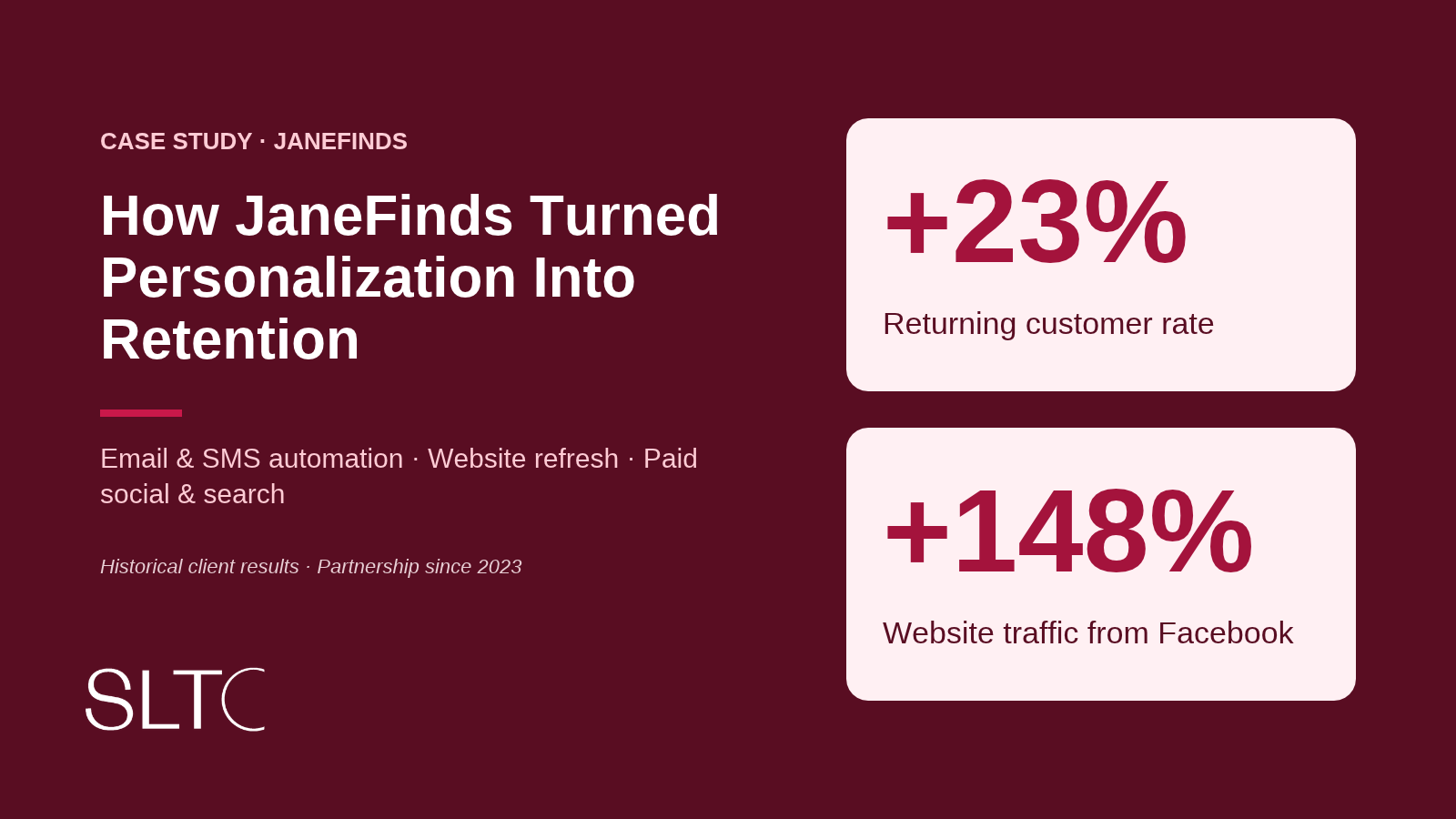
When we partnered with JaneFinds, the luxury handbag reseller, our work spanned email and SMS automation, a website refresh, and paid media. The results included a 23% increase in returning customer rate and a 148% lift in website traffic from Facebook.
These are historical client outcomes, not results from the 2026 holiday season. But they illustrate a principle that applies directly to your holiday planning: customer understanding combined with personalized messaging and coordinated channels improves both retention and revenue.
For luxury and high-consideration purchases, retention doesn't come from sending another discount. It comes from knowing what your customers value and giving them a reason to return with relevance and intention.
Make Your Holiday Customer Data Work Harder With Email, SMS, and Klaviyo
Build Smarter Segments From Holiday Shopping Behavior
The cohort tags and discount segments you set up before the season become the starting point for Q1 segmentation. Act on them before the data goes stale.
Priority segments to build:
- New holiday purchasers who need a post-purchase nurture sequence
- Returning VIP shoppers who deserve recognition and early access
- Promotion-sensitive buyers who only purchased during a discount window
- High-value customers based on order size, product category, or purchase frequency
- Browsers who didn't convert during the holiday rush
- Gift buyers vs. self-purchasers where identifiable through consented data
Each segment should receive different messaging, cadence, and offers in Q1. A single post-holiday campaign aimed at the entire list wastes the customer intelligence you just collected.
What Stronger Lifecycle Infrastructure Looks Like in Practice
When we supported The Sak during their migration to Klaviyo, our team developed branded email templates and helped maintain a consistent, curated customer experience throughout the transition. Stronger CRM infrastructure makes it easier to turn customer insights into relevant, scalable communication.
We've also worked with a luxury accessories brand on a holiday marketing audit, budget reallocation, Klaviyo flow restructuring, and an on-site gifting guide. That engagement historically contributed to a 4x increase in Q4 conversion rate and the client's highest revenue month at the time.
Our partnership with Betsy & Adam is one of our longest-running. It began with organic social, email, and website work as the brand moved into direct-to-consumer, and grew over several years to include SMS, paid media, and conversion optimization. Each new channel built on what the last one had established: customer data from email shaped paid audiences, better-fit traffic made site improvements worth more, and stronger conversion lifted the return on everything upstream. That's what sustainable growth looks like over time. It isn't one big campaign. It's a system where each quarter starts from a higher floor.
The common thread: your email and SMS platform is more than a campaign distribution tool. Used strategically, it supports the entire customer lifecycle.
Use Holiday Creative and Shopping Behavior to Shape Your 2027 Content Strategy
Find the Messaging That Made People Act
Your Q4 campaigns will generate a wealth of creative performance data. Before you archive it, mine it for signals you can carry into 2027. Which hooks produced the strongest engagement? Did gift-oriented messaging outperform self-purchase angles? Did user-generated content outperform polished brand creative?
Go back to the log of customer objections you kept during the season. Those objections are content opportunities: questions your audience is asking that your brand can answer proactively through organic search and content.
Turn Seasonal Search Demand Into Evergreen Content
Holiday shopping data reveals which products, categories, and topics your audience cares about most. The smart move is to extend that interest beyond December. Gift guides can evolve into year-round buying guides. Seasonal product comparisons become evergreen category education. Frequently asked questions from holiday shoppers can inform search-optimized collection pages.
Category-specific opportunities to explore:
- Fashion and jewelry: Transform gift discovery data into occasion-based buying guides
- Beauty and wellness: Extend holiday skincare interest into education and replenishment content
- Home and lifestyle: Convert gift-oriented content into evergreen product discovery
- Food and beverage: Explore hosting, entertaining, and subscription opportunities
Don't abandon your strongest holiday content. Figure out what made it resonate and find ways to give it a longer life.
Reallocate Your Marketing Budget Based on Customer Quality
Determine Which Channels Deserve More Investment
Budget decisions for 2027 should be grounded in customer quality, not just holiday sales volume. Look at which paid campaigns attracted buyers who made second purchases or engaged beyond the transaction. Identify which audiences relied heavily on promotions and which converted at healthier margins.
Where did landing-page friction hurt conversion? Did organic content assist discovery during the holiday period? How did email and SMS perform as repeat-purchase drivers? These answers should directly inform where you reallocate spend.
Connect Your Paid, Owned, and Organic Channels
A common budget mistake is treating each channel as its own silo. Holiday data gives you a clear reason to connect them. If a paid beauty campaign identified a high-performing product, that insight should shape your email creative, your landing page strategy, your organic social calendar, and your post-purchase flows at the same time.
When you build your 2027 e-commerce growth plan around what you learned about customers rather than simply repeating what sold, every channel works harder because they're working together.
Build Your First 90 Days of 2027 Around Three Growth Priorities
A 90-day roadmap keeps post-holiday momentum from dissolving into reactive execution. We recommend anchoring it around three priorities: a Revenue Anchor (the channel with the clearest path to measurable returns), a Brand and Storytelling Anchor (creative and content investment that builds long-term equity), and a Customer Experience Anchor (lifecycle, website, or service improvements that deepen relationships). Assign a named owner and measurable KPI to each before the quarter begins.
Days 1 to 30: Audit and Align
Your marketing lead owns this phase. Review holiday and BFCM performance across all channels using the cohorts you tagged, identify your strongest customer cohorts, audit lifecycle flows and conversion paths, and define three measurable growth priorities. The output: a scorecard every team member can reference.
Days 31 to 60: Build and Activate
Channel owners take the lead. Launch updated retention segments in Klaviyo, refresh priority creative and landing pages, implement new or improved lifecycle flows, and reallocate test budgets toward validated opportunities.
Days 61 to 90: Test, Learn, and Optimize
Your analytics lead synthesizes results. Once each holiday cohort has reached its full follow-up window, evaluate retention, compare customer quality across acquisition sources, optimize campaigns and conversion journeys based on Q1 data, and update forecasts. Scale what's working; pause what isn't.
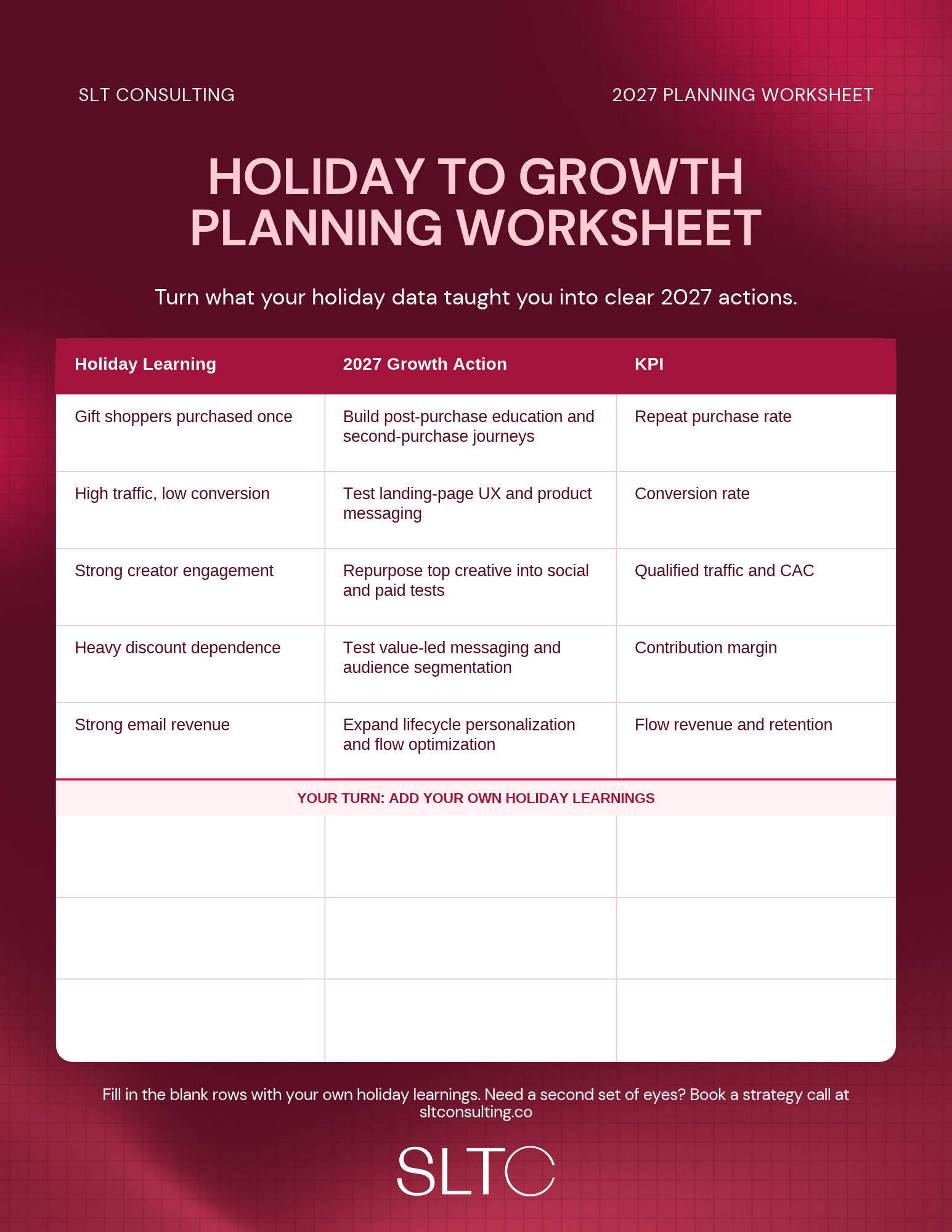
Holiday to Growth Planning Worksheet
Apply the Same Thinking Beyond Traditional E-Commerce
Holiday and seasonal learnings aren't limited to product-based retail. The same setup applies to service-oriented and experience-based brands: tag seasonal inquiries and bookings by window and offer, then read them on an equal timeline. Wellness and beauty providers can turn seasonal interest into ongoing appointments. Hospitality brands can convert peak-season visitors into repeat bookings. Mission-driven brands can learn which communities inspire sustained connection.
Whatever you're selling (products, services, or experiences), your strongest seasonal results should inform what comes next.
Final Takeaway
Your 2027 growth plan starts before the holiday season ends. The brands that build lasting momentum treat their seasonal data as a strategic asset, and that starts with setting it up to be read: tagged cohorts, clean discount segments, and a fair window for judging retention.
At SLTC, we believe growth comes from understanding what your customers are telling you and building a plan around those insights, not simply doing more of what worked during a promotional weekend.
If you're ready to turn this season into a practical roadmap, download the 2027 Growth Planning Workbook to get started.
And if you want a strategic partner to help you connect the dots across channels, we'd love to talk.
Frequently Asked Questions About Holiday Data and 2027 Growth
What should e-commerce brands set up before BFCM to measure holiday performance?
Set up cohort tags by first-purchase window (Black Friday, Cyber Monday, December), segments that separate discount buyers from full-price buyers, consistent campaign and UTM naming, and order-level margin data. Agree on an equal follow-up window, such as 60 or 90 days, so January retention comparisons are fair across cohorts.
What should e-commerce brands analyze after the holiday shopping season?
Focus on revenue quality, not just volume. Analyze contribution margin (after product costs, fulfillment, payment fees, and ad spend), customer acquisition cost, conversion rates by channel, returning vs. new customer cohorts, and repeat purchase potential. These metrics reveal which holiday results can translate into sustainable 2027 growth.
How can Black Friday and Cyber Monday results improve a 2027 marketing strategy?
BFCM data reveals customer preferences, productive acquisition channels, merchandising opportunities, and areas where budget should shift. Use promotional results to identify which audiences purchased at healthy margins and which required heavy discounts, then adjust your 2027 channel mix accordingly.
How do you turn holiday shoppers into repeat customers?
Start with relevant post-purchase journeys tailored to what each customer bought and how they found you. Layer in segmentation, personalization, and loyalty-building touchpoints. At SLT Consulting, we help brands design lifecycle strategies that move holiday buyers toward second and third purchases with intention.
How can Klaviyo support holiday customer retention?
Klaviyo offers automated flows, behavioral segmentation, personalized communications, and cohort reporting that make retention actionable. By tagging holiday cohorts before the season and building targeted flows for new holiday buyers, VIP customers, and lapsed shoppers, brands can deliver timely, relevant messages that encourage repeat engagement.
How do you assess whether holiday discounts attracted profitable customers?
Look at customer-level contribution margin after accounting for product costs, fulfillment, payment processing, and acquisition spend. Track whether discount-acquired buyers make subsequent full-price purchases or only return during the next promotion. Separating discount and full-price buyers before the season starts makes this analysis far easier.
